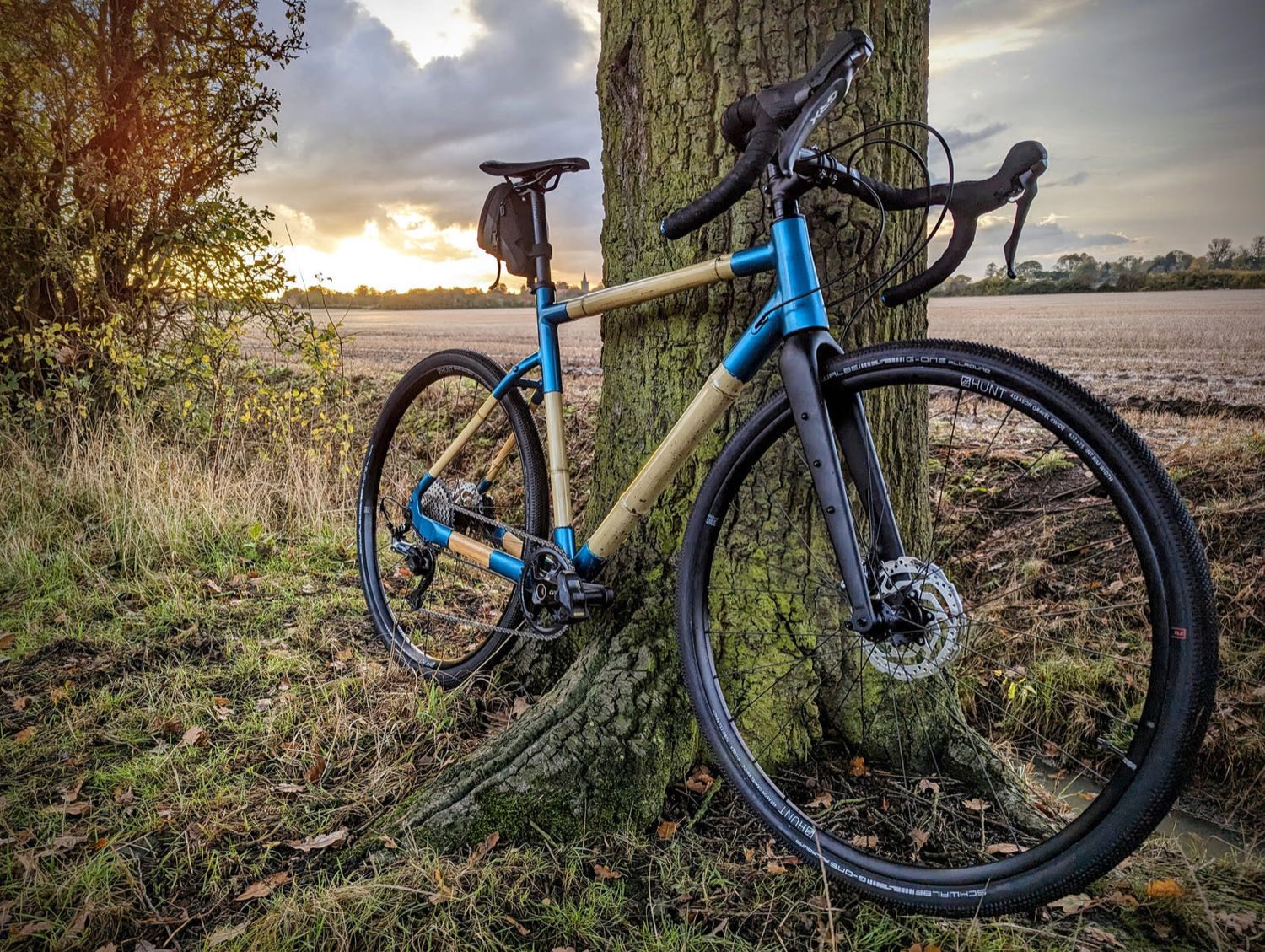
A bamboo gravel bike on a dramatic coastal clifftop
Why Bamboo?

The only frame material you can build yourself, by hand, in a weekend

Bamboo grows on every continent except Europe and Antarctica — nearly 1,600 species. No factories, foundries or billion-dollar supply chains. Anyone can build their own bamboo frame in two days.

0.7
g/cm³ — a tenth the weight of steel
Bamboo's low density vs steel 7.85 g/cm³
~50%
lower carbon than aluminium
Peer-reviewed LCA · Agyekum et al. 2017, Wageningen Univ.
4,000+
Builders trained since 2012
Across 36 countries
3,500+
frames built & ridden
real-world durability proof
Tested

Watch: bamboo under test

Our own bamboo tubes under three-point flexural testing at Swansea University — to ISO standard.

We sent our actual bamboo tubes to Swansea University for three-point flexural bending tests. They behaved like a high-performance engineering material — because they are one.

Read the Swansea study

The engineering

How bamboo measures up

A frame material lives or dies on four numbers: how light it is, how strong for that weight, how it soaks up the road, and what it costs the planet. Bamboo against the metals and carbon — honest ranges, with sources.

0.7
g/cm³ density
Lighter than carbon, aluminium & steel
High
strength-to-weight
Light, stiff and tough
3–5
years to harvest
A tree takes decades
4,000+
builders trained
A skill you keep for life

Density · g/cm³ — lower is lighter

Steel (4130)7.8
Aluminium 60612.7
Carbon fibre1.5
Bamboo0.7
PropertyBambooSteel (4130 / 853)Aluminium 6061Carbon fibre
Density (g/cm³)0.6–0.97.82.71.5
Tensile strength (MPa)115–370560–1,400310600–3,500 †
Stiffness — modulus (GPa)10–3520569120–200
Vibration dampingHighVery lowLowModerate
Embodied carbon (kg CO₂e/kg)Net‑negative0.8–2.8~5.424–35
Build it yourself?Yes — jig & hand toolsBrazing / weldingWeldingAutoclave — no

Ranges reflect species, alloy and lay-up — bamboo especially varies with species, culm and moisture. † Carbon's headline strength is measured along the fibre; a frame tube only ever sees a fraction of it. Sources: Sánchez Vivas (bamboo.org), ScienceDirect, MatWeb/ASM, Reynolds Technology, ICE embodied-carbon database.

Carbon is lighter and stiffer. Bamboo answers on damping, fatigue-tolerance and embodied carbon — and it is the only one of the four you can build yourself, by hand, in a weekend.

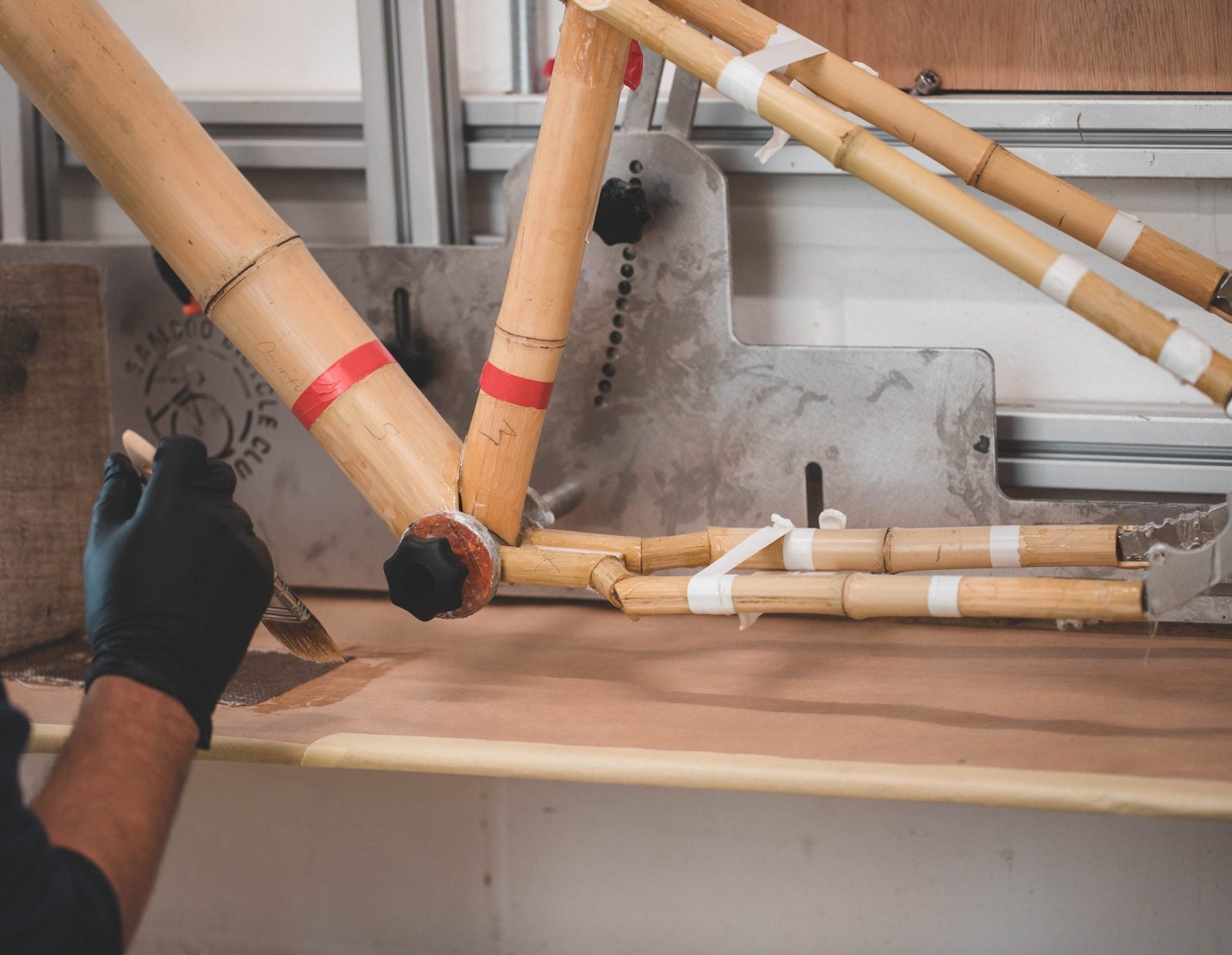
A flax-and-carbon reinforced joint on a bamboo frame, showing the natural fibre structure
The science

Comparable to steel — at a fraction of the weight

Bamboo's tensile strength is comparable to mild steel — at roughly a tenth of the weight. It's a natural composite: parallel cellulose fibres in a lignin matrix running the full length of the culm, the same structural principle as carbon fibre, evolved over millions of years.

Gram for gram it holds its own against steel and even carbon fibre — an exceptional strength-to-weight ratio (Wegst & Ashby, Philosophical Magazine, 2004). We tested our actual tubes with Swansea University: flexural and tensile tests confirmed high stiffness and strength for the weight, and every joint is reinforced with a flax-and-carbon composite.

Woody turned out to be the most reliable bike I've ever owned. Hardly any mechanical problems on the whole journey, and a smooth, shock-absorbing ride.

Kate Rawles — 8,288 miles, Colombia to Patagonia, on a BBC-built bamboo frame

Read the Swansea University study

Riding a finished bamboo bike on the road
Ride quality

A ride you can actually feel

Bamboo is a natural composite, and natural fibres damp vibration better than bare metal. This isn't just feel: in peer-reviewed testing at Oxford Brookes University, a bamboo frame significantly improved ride comfort over an aluminium one (Thite et al., Vehicle System Dynamics, 2013). Paired with the right geometry, that means less road buzz on long days in the saddle.

Having had it now for about 7 years and ridden it hard — the ride is much smoother than my Cooper. I've ridden over about half of Crete with it.

Jamie — London workshop builder, 7-year review
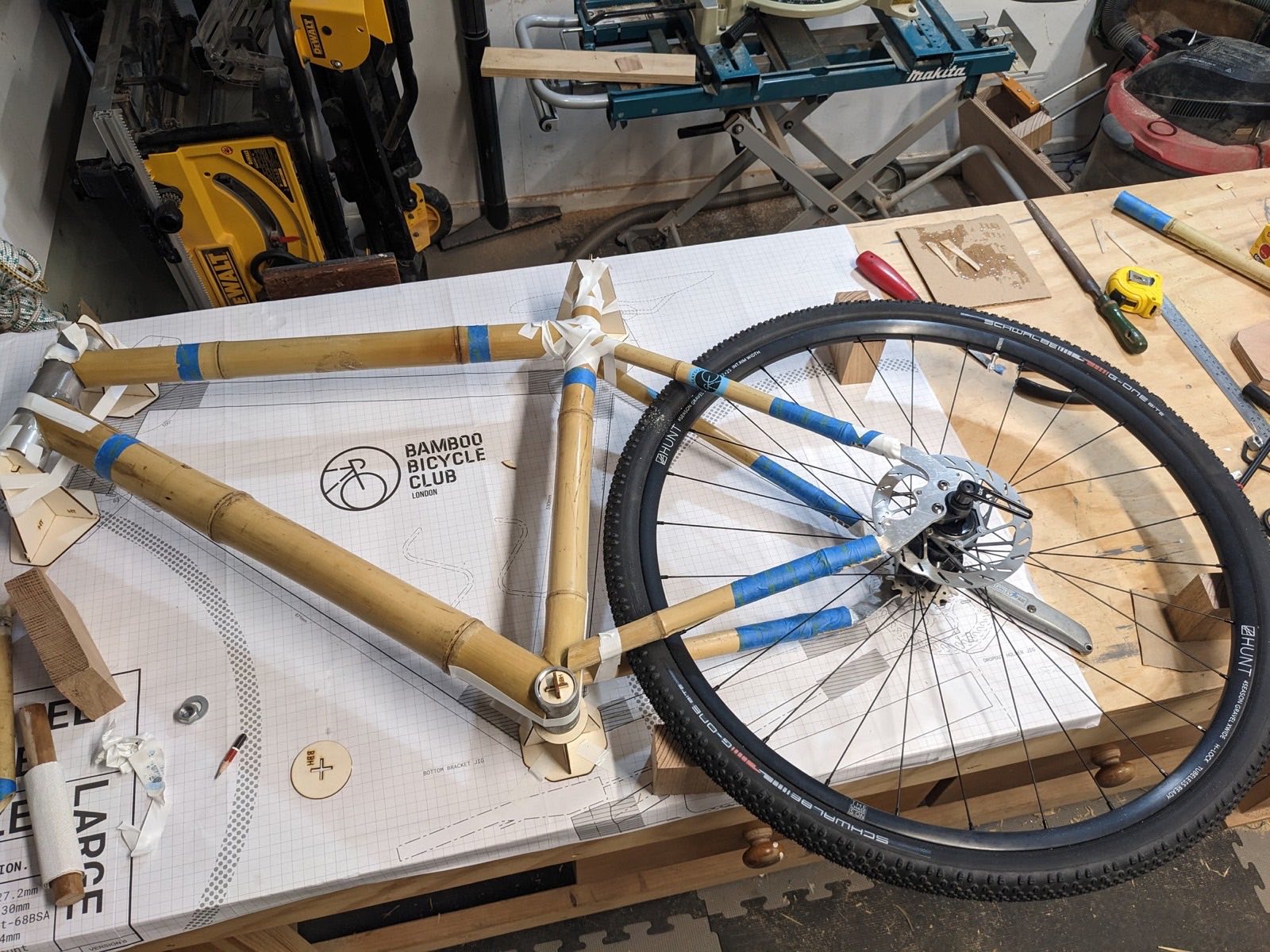
A bamboo frame on the build jig with hand tools — no factory needed
Accessibility

Why it matters

To make an aluminium frame you need bauxite mines, smelters running near 1,000°C and factories of CNC machines. Carbon fibre needs petroleum-derived precursors, autoclaves and clean rooms.

To make a bamboo bicycle frame you need bamboo, a jig, hand tools and two days. That's it.

We teach beginners — most with no prior experience at all — to build their own frame in a weekend. Through our Build to Bond programme, frame-building reconnects fathers with their children inside the criminal justice system.

I knew nothing about bike maintenance. I thought that if I could be involved in the whole process of putting it together, I'd have a better idea of how to tackle any inevitable breakages. It reminded me how satisfying it is to build something from scratch.

Soraya — 4-day London workshop, road bamboo bike build
Raw bamboo culms in the workshop — frame-grade in three to five years
Sustainability

Grown, not mined

Bamboo reaches structural maturity in 3–5 years where trees take 20–50; it regrows from its own root system with no replanting, pesticides or irrigation, locking up carbon as it grows. A peer-reviewed life-cycle assessment of a bamboo bicycle frame measured around 50% less environmental impact than aluminium and about 30% less than steel (Agyekum, Fortuin & van der Harst, Journal of Cleaner Production, 2017).

To make an aluminium frame you need bauxite mines, smelters near 1,000°C and factories of CNC machines. A bamboo frame needs a plant, a jig and a pair of hands.

See how every kit funds learning

Proven with science

The evidence behind the bike

We don't ask you to take "bamboo is good" on faith. Independent universities and peer-reviewed journals have measured what a bamboo frame actually does.

  • University College London
  • Oxford Brookes University
  • Swansea University
  • London South Bank University

A measurably better ride

Frequency-response testing found a bamboo frame significantly improved ride comfort over an aluminium one.

Thite et al., Vehicle System Dynamics, 2013 — Oxford Brookes University

Around half the carbon

A life-cycle assessment of a bamboo bicycle frame measured ~50% lower environmental impact than aluminium, ~30% lower than steel.

Agyekum, Fortuin & van der Harst, J. Cleaner Production, 2017 — Wageningen University

Tested to outlast its life

Independent load and fatigue testing modelled a bamboo frame to outlast roughly 26× its intended service life.

Arango Fierro et al., IntechOpen, 2019 — Univ. Autónoma de Occidente

Flax-reinforced joints

We bond joints with flax — a natural fibre prized for stiffness, low weight and outstanding vibration damping.

Amiri et al., Proc. IMechE Part P, 2018 — North Dakota State University

Bamboo's mechanical properties can be measured to a recognised international standard, BS ISO 22157. We've also tested our own tubes with Swansea University.

Good to know

Bamboo bike questions, answered

Does a bamboo bicycle frame crack or split?

Properly treated and sealed bamboo is very stable. Our tubes are heat-treated to remove moisture and sealed with epoxy resin. Store indoors and avoid prolonged exposure to extreme wet conditions.

Can I ride a bamboo bike in the rain?

Yes. Finished frames are fully sealed with epoxy resin. Dry your bike after wet rides and store it indoors — the same care you'd give any quality frame.

How strong is a bamboo frame?

Bamboo has a superb strength-to-weight ratio — gram for gram it rivals metal while being far lighter. In absolute terms its tensile strength is comparable to mild steel rather than high-strength steel, and it doesn't need to be stronger: every joint is reinforced with a flax-and-carbon composite, and independent engineers have load-tested and fatigue-modelled bamboo frames to well beyond their service life (Arango Fierro et al., 2019). Bamboo's properties can be measured to a recognised international standard, BS ISO 22157.

What about the joints?

The carbon-and-epoxy lugs are engineered so the joint is never the weak point — in our builds the bamboo itself is the limiting factor, not the joins. The method has been refined over 13 years and 4,000+ builds.

How long will a bamboo frame last?

Built to last. Many of our 2012 frames are still ridden daily — 13 years on — and across 4,000+ builds, frame failures are rare. Keep it sealed and stored indoors and it will go the distance.

Do I need experience to build one?

No — most of our builders start with no prior experience. Workshop frames are completed in 2 days with full expert guidance; home kits include step-by-step instructions and video tutorials.

What types of bamboo bicycle can I build?

Any type — road, gravel, mountain, cargo, tandem, balance bike. The geometry is defined by your jig setup, so the design is up to you.

Is bamboo a sustainable material for bicycles?

Yes. Bamboo is a rapidly renewable grass — it matures in 3–5 years (trees take 20–50), regrows from its root system, and needs no pesticides or irrigation. And because you build the frame yourself, you learn to repair it, so it lasts for years rather than being thrown away.

Ready to build your bamboo bike?

Join 4,000+ people who've built their own bamboo bicycle frame.

Shop frame kits