 Tandem
swiss family tandem
Three-person bamboo tandem for the school run. Built at home in Switzerland.
Read the build

Every workshop opens with the same question. This is the material, measured.
01the science
Bamboo's fibres turn road buzz into a trace of heat — so less of the rough road ever reaches your hands.
A bamboo frame significantly improved ride comfort over an equivalent aluminium one.

02strength & ride
Tensile strength comparable to mild steel — tested to BS ISO 22157 at Swansea — with flax-and-carbon joints. It gives over the bumps and stays stiff under power, so it moves with you.
Independent engineers fatigue-modelled a bamboo frame to outlast around 26 times its intended service life.
Filmed in the materials lab at Swansea University.
We sent our own bamboo tubes to Swansea University for three-point flexural bending tests to BS ISO 22157. They behaved like a high-performance engineering material — because they are one.
We don't just build with bamboo — we study it, and we teach it. A decade of testing, student projects and peer-reviewed research.
The studies.
The programmes. University College London — the “Pedal Progress” cargo-bike project, winner of the IMechE Group Project Award · University of Manchester — bamboo-composite materials R&D · London South Bank University — jig-equipped engineering-lab teaching · Coventry University — UK Bamboo Summit keynote · University of Portsmouth — bamboo species study · University of Cumbria — Kate Rawles’ 8,288-mile “Woody”.
A frame material comes down to how light it is, how strong for that weight, how it soaks up the road, and whether you can build it yourself. Honest ranges, with sources.
Density · g/cm³ — lower is lighter
| Property | Density (g/cm³) | Tensile strength (MPa) | Stiffness — modulus (GPa) | Vibration damping | Build it yourself? |
|---|---|---|---|---|---|
| Bamboo | 0.6–0.9 | 115–370 · ours 84.3 † | 10–35 | High | Yes — jig & hand tools |
| Steel (4130 / 853) | 7.8 | 560–1,400 | 205 | Very low | Brazing / welding |
| Aluminium 6061 | 2.7 | 310 | 69 | Low | Welding |
| Carbon fibre | 1.5 | 600–3,500 † | 120–200 | Moderate | Autoclave — no |
Ranges reflect species, alloy and lay-up — bamboo especially varies with species, culm and moisture, which is exactly why we test to a standard. Our 84.3 MPa is a real culm section tested at Swansea (BS ISO 22157). † Carbon's headline strength is measured along the fibre; a frame tube only ever sees a fraction of it. Sources: Swansea University test data; Sharma & Harries (2015); Wegst & Ashby (2004); MatWeb / ASM.
And carbon wins on stiffness-to-weight. We publish the figure that lost as well as the one that won — every number above is an independent lab's, not ours.


We don't ask you to take "bamboo is good" on faith. We test it, we teach it, and we work with universities to understand it better.
the greenest material is the one you understand.
* understand what bamboo is, how it grows and how it's joined, and you use it better — you waste less, repair instead of replace, and keep improving. that's why everything we do is teaching.
03accessibility
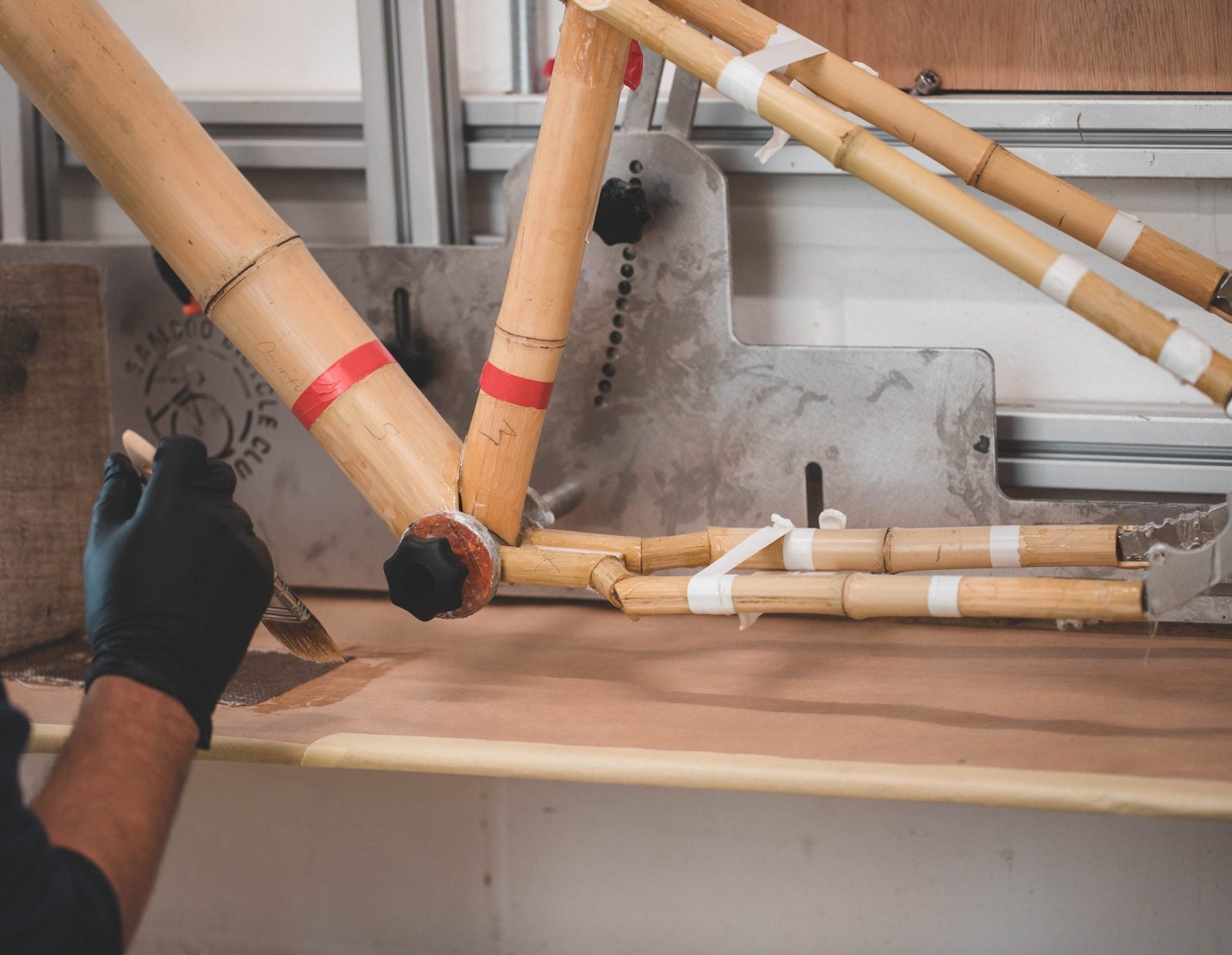
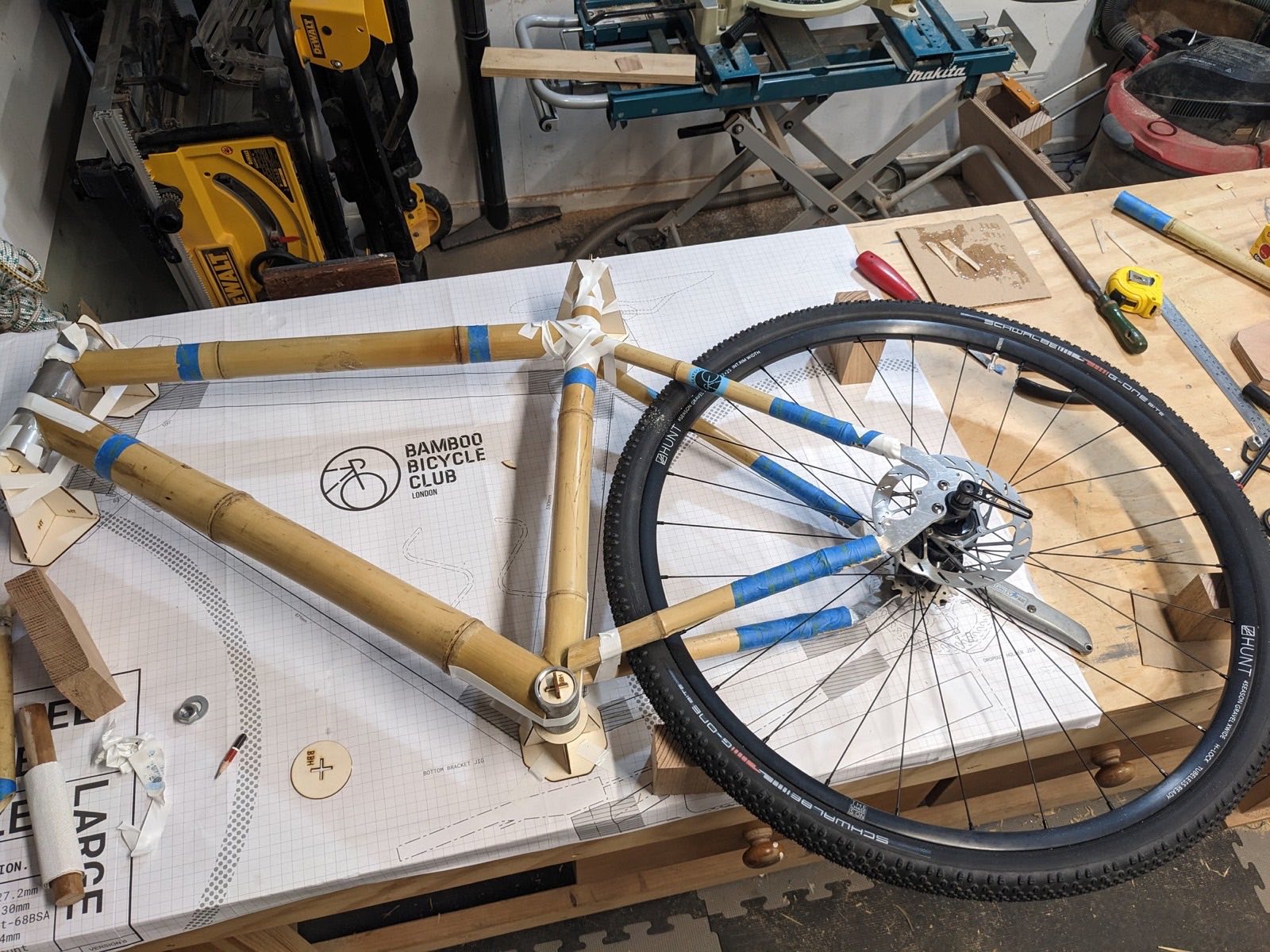
No welding, no moulds, no factory — just bamboo, a jig and hand tools. Most builders start with zero experience and finish in two days.
I knew nothing about bikes. Building the whole thing myself, I finally understand how to fix it.
You can't shape steel in your kitchen or cut carbon in your garage. Bamboo you cut with a hand saw and join with flax wrapping and bio-resin — so you can build any frame you can draw.
TandemThree-person bamboo tandem for the school run. Built at home in Switzerland.
Read the build

Long-tail cargo built in a London flat. "Surprisingly solid, takes quite a load."
Read the build
 Aero Road
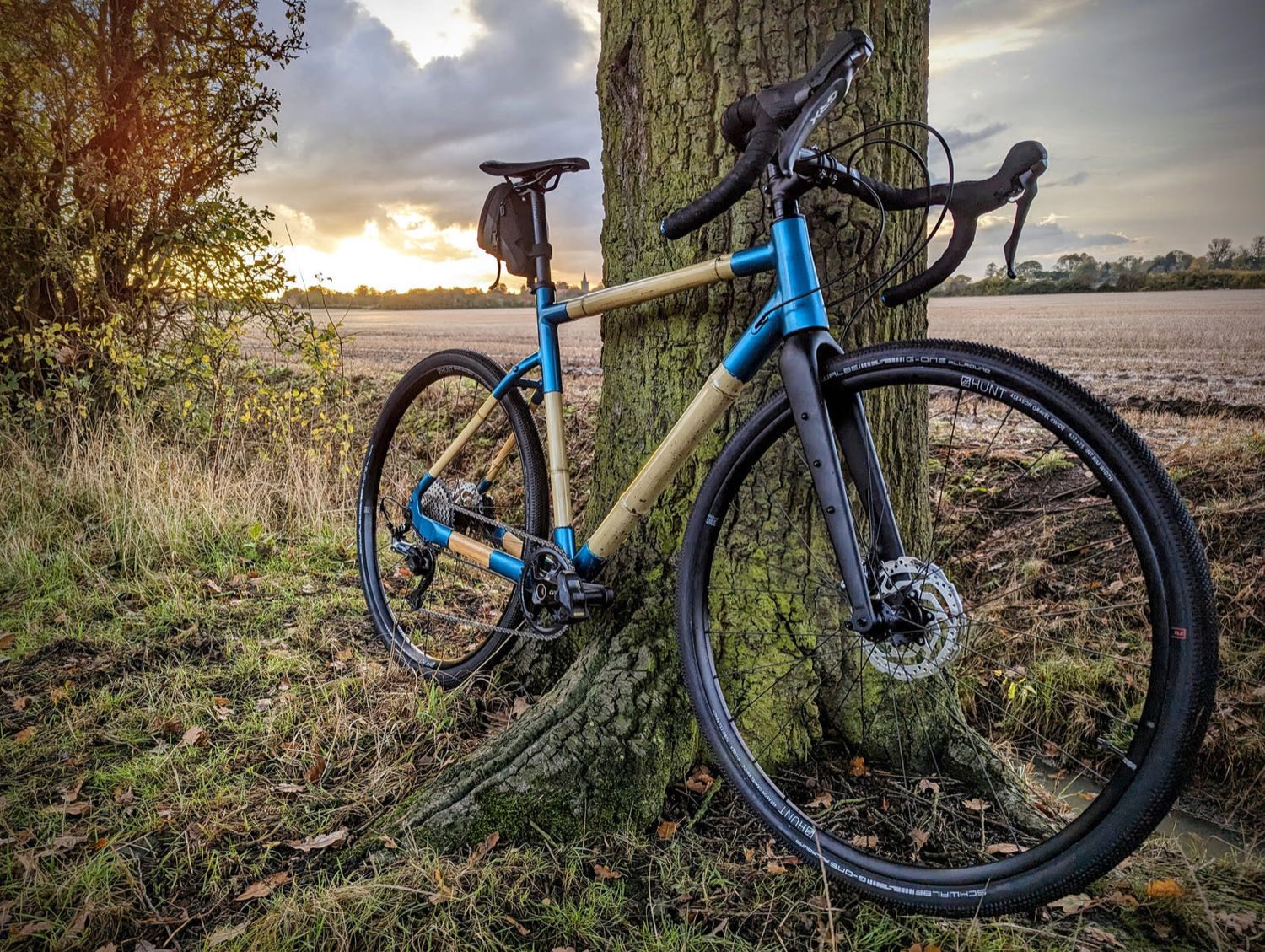
 Gravel
First-time builder from the Netherlands. "My hands are itching to build a second."
Read the build
 10-Year Rider
Comparable to mild steel in tension — about 84 MPa, tested to BS ISO 22157 at Swansea University — while far lighter. Every joint is reinforced with a flax-and-carbon composite, so in our builds the bamboo is the limiting factor, not the joins, and independent engineers have fatigue-modelled bamboo frames well beyond their service life (Arango Fierro et al., 2019).
Our tubes are heat-treated, bound in flax and bio-resin at the joints, and sealed with lacquer. Dry after wet rides and store indoors — the same care you'd give any quality frame.
No — most of our builders start with none. Workshop frames are completed in 2 days with full expert guidance; home kits include step-by-step instructions and video tutorials.
Many of our 2012 frames are still ridden daily, 14 years on. Keep it sealed and stored indoors and it goes the distance.
Any type — road, gravel, mountain, cargo, tandem, balance bike. The geometry is defined by your jig setup, so the design is up to you.
Yes. It matures in 3–5 years (trees take 20–50), regrows from its root system, and needs no pesticides or irrigation. And because you build the frame yourself, you learn to repair it — so it lasts for years rather than being thrown away.
Most builders start with zero experience — the manual and video course carry you the whole way.