Build to Bond: The Full Story of How Bamboo Bikes Are Rebuilding Family Connections in Prison
Share
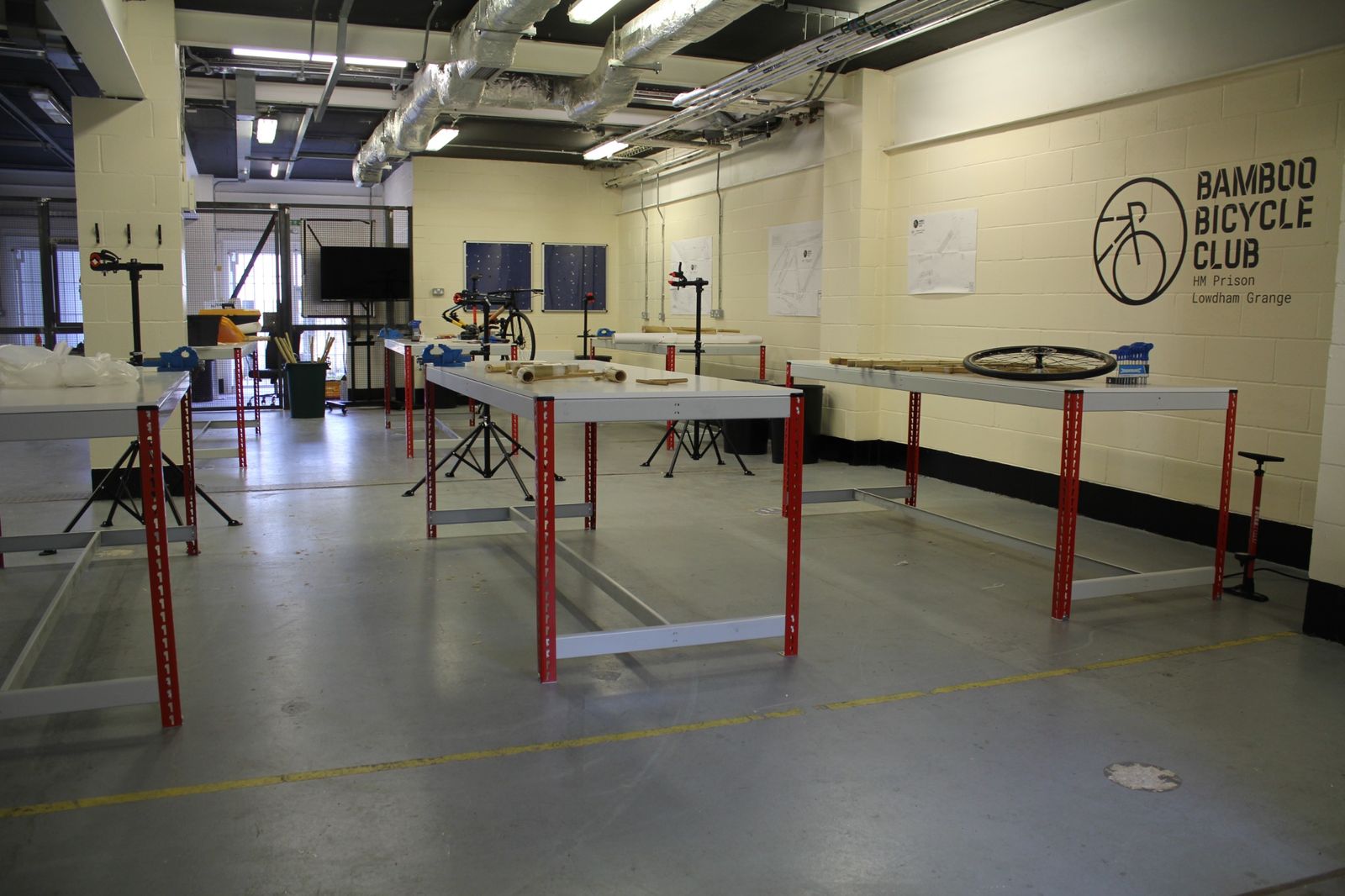
A Category B prison in Nottinghamshire. A 2,000 square foot workshop. Bamboo, hemp, and hand tools. And a waiting list — because no one wanted to miss it.
Build to Bond is not a craft project. It is not a "keep prisoners busy" programme. It is a structured, accredited rehabilitation pathway in which incarcerated Makers learn sustainable manufacturing, earn a nationally recognised qualification, and build a bicycle with their own hands — often for the child waiting at home for them.
The Financial Times covered it in September 2025. The UK Prisons Minister endorsed it publicly. And the 3,500+ people who have built bamboo bikes through Bamboo Bicycle Club — most of them free, most of them paying — are the proof that this approach works at scale.
Why Bamboo?
Bamboo has the tensile strength of steel. It can be cut and shaped with hand tools — no lathes, no CNC machines, no specialist equipment that cannot safely exist inside a Category B prison. It is a renewable material that grows back within three to five years. And it looks extraordinary when finished.
That last point matters more than it sounds. When a Maker holds their finished frame, something shifts. The object in their hands is undeniable proof that they are capable of more than they knew.
"For a lot of prisoners, the programmes offered are quite dull, but bamboo bikes have that cool factor that excites them. In the programme there is maths and English, but it is built into design, creativity and bike mechanics."
— James Marr, Founder, Bamboo Bicycle Club (Inside Time, November 2025)
Over 14 years and 4,000+ people trained across 36 countries, Bamboo Bicycle Club has refined what works when teaching non-engineers to build something durable, precise, and beautiful. Build to Bond takes that curriculum into the places it is needed most.
How the Programme Works
Each cohort runs for six weeks, four hours a day — eighteen hours of structured workshop time per week. Twelve Makers per cohort. They work through:
- Week 1–2: Foundation and materials science. Workshop safety, bamboo properties, frame geometry, technical drawing. The maths is real; it is embedded in measurement and design.
- Week 3–4: Frame construction. Cutting and preparing bamboo culms. Hemp-fibre and bio-resin joining at the nodes. Building the frame incrementally, checking geometry at every stage.
- Week 5: Mechanics and finishing. Wheel-building, component assembly, paint and finishing techniques. The bike becomes a complete, rideable object.
- Week 6: Enterprise and completion. Business basics. What sustainable manufacturing looks like as a career. Qualification assessment. And — for those who qualify — entry into Build to Bond itself.
Three participants at HMP Lowdham Grange have been trained as peer instructors. They co-deliver elements of the programme alongside BBC staff. This is not a cost-saving measure — it is by design. Peer instruction is one of the most powerful learning mechanisms there is, and it transforms participants into leaders.
"The bamboo bike course offers more than just technical training — it provides an avenue for creativity, teamwork, and self-expression."
— Sally Allsopp, Industries Manager, HMP Lowdham Grange
The Build to Bond Moment: Building a Bike for Your Child
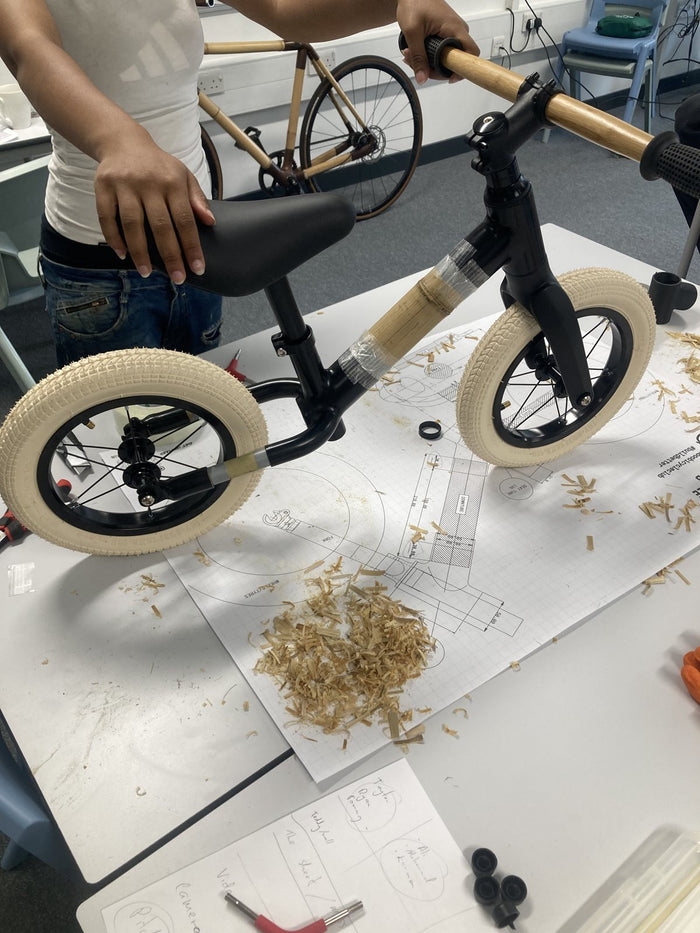
Build to Bond is the follow-up course for Makers who complete the foundation programme. In it, they build a children's bamboo balance bike — small, light, perfectly proportioned for a toddler — and gift it to their child, grandchild, nephew, or niece.
The kit uses the same materials as the full-size frame: natural bamboo, hemp fibre, bio-resin, water-based paint. The build process mirrors the one the Maker has already mastered. But the purpose is entirely different.
"When one Maker received a balance bike kit for his toddler, he was inspired and excited that he could create something — and suddenly all that communication developed with his daughter that he might never have had."
— James Marr, describing a Build to Bond participant (Financial Times, September 2025)
The bike is not symbolic. It is a functioning object. The child rides it. The Maker built it. The connection between those two facts is real and permanent — it exists regardless of what comes next.
The Evidence on Family Ties and Reoffending
The Ministry of Justice research is unambiguous: maintaining family contact during a prison sentence is one of the most reliable predictors of successful rehabilitation. People who stay connected to their children and partners are 39% less likely to reoffend after release.
Most prison programmes cannot create that connection — they can only try to work around its absence. Build to Bond builds it directly into the programme structure. The bike is a letter that cannot be ignored. It sits in the hallway. The child asks where it came from. The answer is their parent.
Every year a person reoffends costs the public purse over £40,000. The maths on Build to Bond — at £200 per learner — does not require advocacy. It requires arithmetic.
What the Numbers Say
At HMP Lowdham Grange, the results have been consistent across cohorts:
- High completion and engagement rates. The programme had a waiting list from its first cohort. In an environment where disengagement is the default, this is not a small thing.
- ~26% confidence uplift. Pre- and post-programme self-efficacy measures show a consistent improvement. Makers leave with evidence — physical, irrefutable — that they can learn, create, and complete difficult things.
- OCN London Level 2 in Sustainable Manufacturing. A nationally recognised qualification. It goes on a CV. It opens doors to further education and employment in construction, engineering, and composites manufacturing.
- 3 peer instructors trained. The programme is beginning to sustain itself from within, with participants becoming part of its delivery.
- 3,500+ bikes built across BBC's full programme history — proving the model, the materials, and the method.
National Recognition
In September 2025, the Financial Times published a full feature on Build to Bond. The article described how BBC "taps into the IKEA effect" — the extra affection people reserve for objects they make themselves — and explored how that effect is amplified when the object is built for your child during a period of separation.
The same month, James Timpson — the UK Prisons Minister, and the man whose family business employs more ex-offenders than any other UK company — gave his public endorsement.
"Innovative projects, such as Build to Bond, support rehabilitation and help people leave prison as better citizens, boosting the economy and keeping our streets safe."
— James Timpson, UK Prisons Minister (Financial Times, September 2025)
In November 2025, Inside Time — the newspaper read by over 100,000 prisoners across the UK — ran a feature on the programme. Bamboo Bicycle Club was also named one of four winners of the Investec Beyond Business 2025 award, receiving £24,000 to support expansion.
In January 2026, Build to Bond was featured at the National Justice Museum in Nottingham — a bike built at Lowdham Grange put on permanent display.
What Comes Next
Build to Bond launched at HMP Lowdham Grange. It is now expanding across the UK prison estate — to Category C training prisons, women's prisons, and Young Offender Institutions where the case for hands-on, family-connected rehabilitation is just as strong.
Each new prison needs a workshop space, a trained instructor, and a willingness to try something that the Makers on the waiting list already know works.
If you represent a prison and want to explore bringing Build to Bond to your site — or if you are a funder, commissioner, or corporate partner who wants to support the expansion — we would like to hear from you.