Trained with us, now building in Nairobi: Kirui's bamboo bikes for Kenya
A Kenyan innovator featured on NTV’s Earthwise Mtaani is building bamboo bikes in Nairobi as climate action — and he learned the craft with us in London, on a Chevening scholarship. The story of how one workshop ripples out to...
Figures from BBC programme records. Reoffending is a contested measure — we report what we can verify.
A Kenyan innovator featured this month on NTV’s Earthwise Mtaani is building bamboo bicycles in Nairobi as climate action — and the craft traces back to a workbench in London. Kirui learned to build a bamboo bike with us, while in the UK on a Chevening scholarship, before taking the skill home to Kenya.
The context
Across Africa, bamboo has served communities for generations — but a new generation of makers is treating it as a climate solution rather than just a resource. In Nairobi, where traffic and rising emissions are everyday realities, one innovator started asking a simple question: what if future mobility could be grown from the soil?
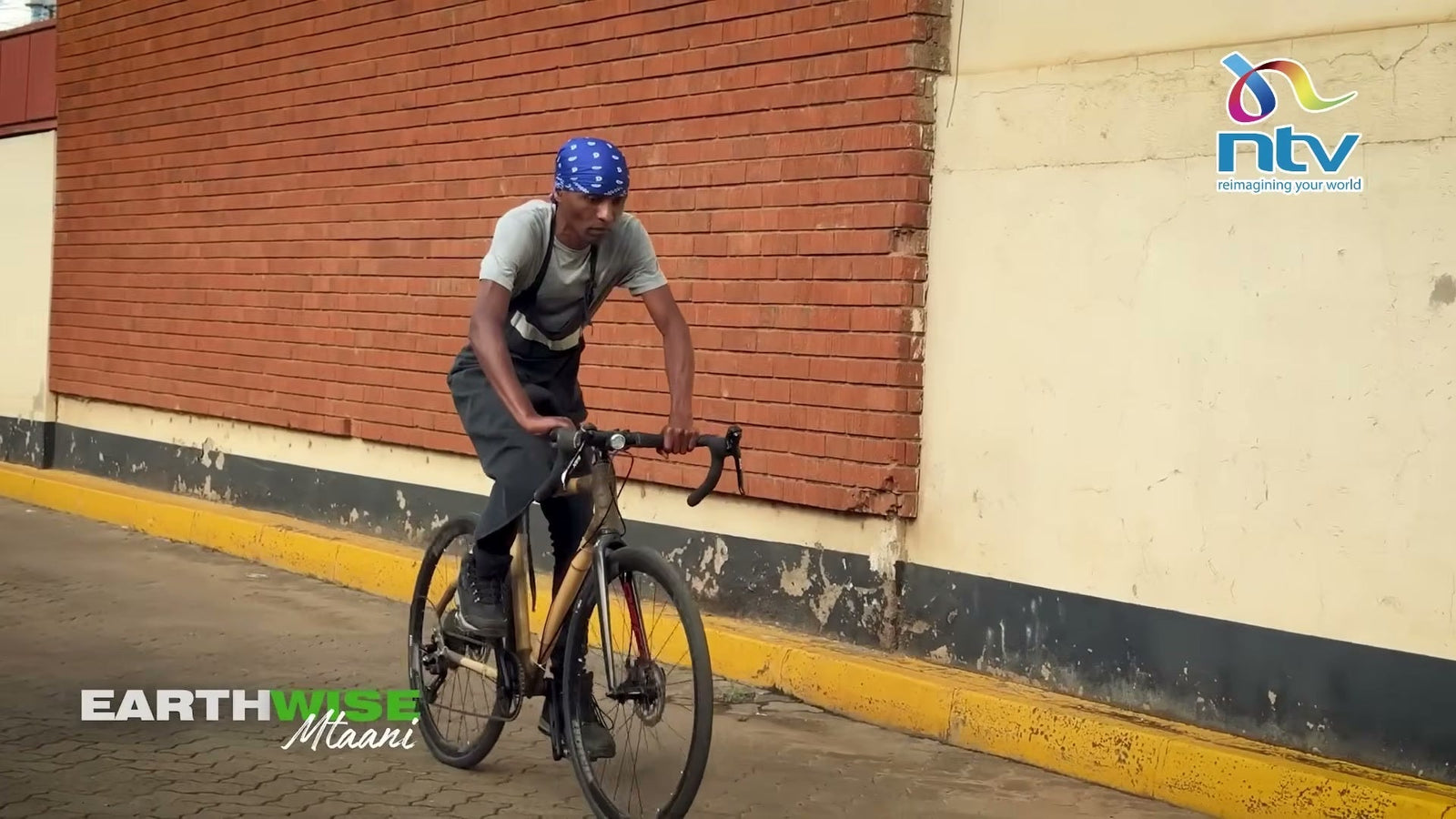
That innovator is Kirui, a maker building bamboo bikes in Nairobi. This month NTV Kenya featured him on its climate-solutions series Earthwise Mtaani, filming inside his workshop as bamboo tubes became bicycle frames. “We are all about sustainable mobility,” he tells the presenters. “This is where bamboo tubes become bicycles.”
The Bamboo Bicycle Club connection
Here is the part of the film that brought us up short. Asked how he got started, Kirui takes the story back to 2021.
“I happened to have gotten the Chevening scholarship to go and study in the UK. And while I was there, I was looking for something that I could bring back and help my community… I came across bamboo bicycles from James, Bamboo Bicycle Club. I knew James. I went and got training there. I made my first bamboo bicycle. I still have it.”
— Kirui, on NTV’s Earthwise Mtaani

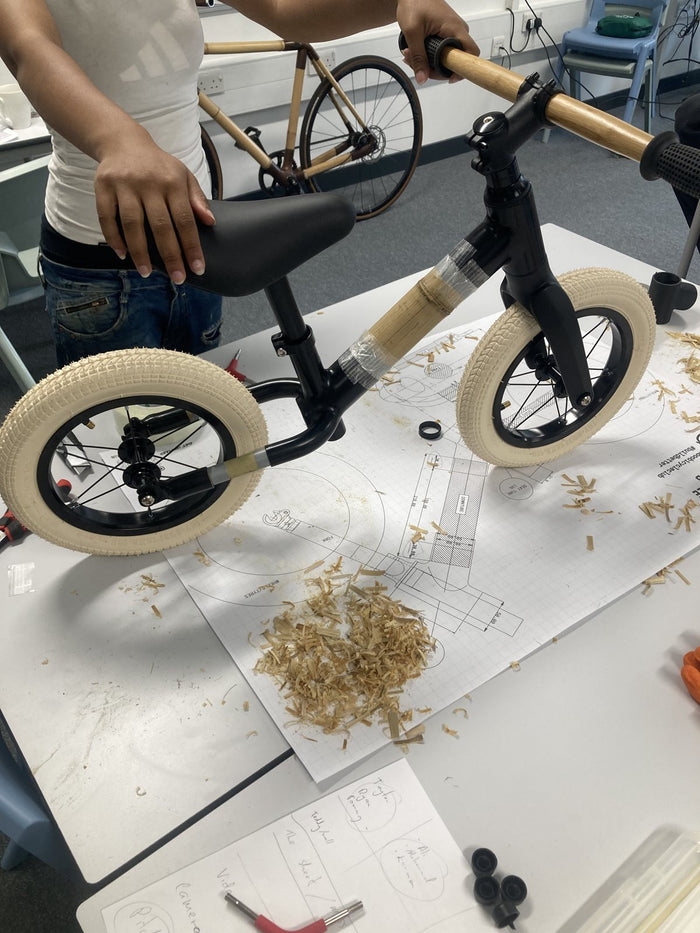
Chevening is the UK government’s international scholarship programme. Kirui came to study, found his way to our London workshop, and built his first bamboo frame on our bench. He took that skill home — and turned it into a business that now teaches other Kenyans to do the same.
We didn’t commission this, fund it, or even know it was being filmed. It is simply what happens when you teach a skill instead of selling a product: it travels, and it keeps building things long after the person has left the room.
What he’s building in Nairobi
His model will look familiar to anyone who has spent a day with us. Kirui offers a workshop experience — come for two or three days and leave with a frame you built yourself — alongside frames he builds to order. He works in two ways: with lugs, and with a lugless method where the bamboo joints are wrapped in flax, a natural plant fibre, and set with resin. He keeps his frames natural rather than painted. “This is actual bamboo,” he says, tapping a finished frame. “There’s nothing inside.”

His material case for bamboo, made on camera, lines up with what we have learned over 13 years of building:
- It’s a grass, not a tree — fast-growing, maturing in around four to six years, and able to grow on poor and degraded land.
- It’s a serious carbon store — that quick growth makes bamboo strong at pulling carbon out of the atmosphere.
- It’s strong — bamboo’s tensile strength is comparable to mild steel, which is exactly why it can be engineered into a frame (and, elsewhere, into buildings).
- It’s light — because it’s hollow, a bamboo frame is light and gives a smooth, vibration-damped ride.
- It’s local — Kirui sources Kenyan-grown bamboo, treats the poles with borax and cures them for about a month before building, and puts income back to the farmers who grow it.

What’s striking is the deliberate twist on the usual model. Bamboo-bike enterprises across West and Southern Africa — in Ghana, Nigeria, Uganda and beyond — have largely built for export. Kirui wants to make bikes for Kenyans to ride at home, train young people to become bike-makers in their own communities, and keep the whole thing circular: a damaged frame can come back, and the parts — even the lugs — can be reused.
A wider network: Kenya, Ethiopia and beyond
On camera, Kirui points to “our latest project with our partner from Ethiopia,” who makes wheelchairs from bamboo. That partner is Abel Hailegiorgis of Bamboo Labs in Addis Ababa — and here the story folds back on itself, because Abel is also a Bamboo Bicycle Club builder. He learned to make bamboo frames with Bamboo Bicycle Club in Munich before going on to build bamboo wheelchairs and bikes for the Ethiopian market.
So: two founders, in two countries, building two kinds of mobility — bikes in Nairobi, wheelchairs in Addis Ababa — both trained at the same club, and now collaborating with each other. Add Ghana Bamboo Bikes in Kumasi, with whom we shared a field at the Imagine Bamboo Summit in Birmingham, and you start to see how far a single idea can travel.
What we can verify
In the spirit of being straight about our claims:
- The NTV Kenya Earthwise Mtaani feature on Kirui is real and public (linked below). His account of training with us on a Chevening scholarship is his own, told to camera.
- Abel Hailegiorgis / Bamboo Labs trained with Bamboo Bicycle Club in Munich — that one we can confirm from our own records and an earlier builder story on this site.
- Bamboo’s tensile strength being comparable to mild steel is well established in the engineering literature, and it’s the same property we rely on in our own frames.
- Figures Kirui cites on camera — for example the United Nations’ count of around 1,500 uses for bamboo — are his to stand behind; we’re repeating them as said, not presenting them as our own research.
- We don’t run his workshop and aren’t claiming credit for it. Kirui built it. Our part was a few days at a workbench, years ago.
- Bamboo Bicycle Club has trained 4,000+ people since 2012, across 45 countries.
Why it matters
The reason we teach self-build rather than only sell bikes is on display in this film. A skill, once given away, doesn’t deplete — it compounds. A scholar from Central Kenya spends a few days in London, and years later there’s a workshop in Nairobi turning out frames, training young makers, and partnering with a wheelchair-builder in Ethiopia. Same material, same belief: that anyone can make something extraordinary with their hands, and that a bicycle can be grown rather than only manufactured.
Watch and links
- NTV Kenya — Earthwise Mtaani: Kenyan innovator making bicycles out of bamboo: youtu.be/EBmY4QpSHo0
- CGTN Africa — “Kenyan startup crafts eco-ride bicycles from bamboo” (8 June 2026)
- Bamboo Labs (Abel Hailegiorgis), Addis Ababa — bamboolabs.org
- Ghana Bamboo Bikes (Bernice Dapaah), Kumasi — ghanabamboobikes.org
- Build your own with us — bamboobicycleclub.org
———
Bamboo Bicycle Club teaches people to build their own bamboo bicycles — workshops in London, kits shipped worldwide — through Bamboo Mobility Project CIC (Company No. 16257348). Since 2012 we’ve helped 4,000+ people across 45 countries build something they didn’t think they could. Every build funds skills inside prisons and schools.
every bike we sell funds a place on the programme.
Fund a cohort, offer placements, or partner with us. This is how stories like this one keep happening.
Support the mission →