Frame-building in Stoke: two college groups, a public masterclass, and Brilliant Bamboo
In early March 2025 we spent three days in Stoke-on-Trent teaching people to build with bamboo — first two groups of further-education students, then a public masterclass — working in partnership with the Staffordshire bamboo organisation Brilliant Bamboo.
The context
Most people who build with us come to our London workshop. But bamboo bicycle building was never meant to stay in one place, and when Brilliant Bamboo — a Stoke-based community interest company founded by Gemma Thomas — asked us to bring a frame-building class north, we said yes.
We know Brilliant Bamboo through the Bamboo in the UK group, an informal network of people working with the material across the country. Gemma's team handled the local organising, the venue and the college links; we brought the bamboo, the bike-frame parts, the tools and the teaching. It was a genuine collaboration between two organisations who care about the same plant.
What we did
The work ran across two days at the start of March 2025.
On Monday 3 March we taught two groups of further-education students, from two different colleges — around ten students in each — in two sessions across the day. They learned the basics of working with bamboo as a structural material: how it is cut, shaped and joined, and how those properties shape what you can build with it.
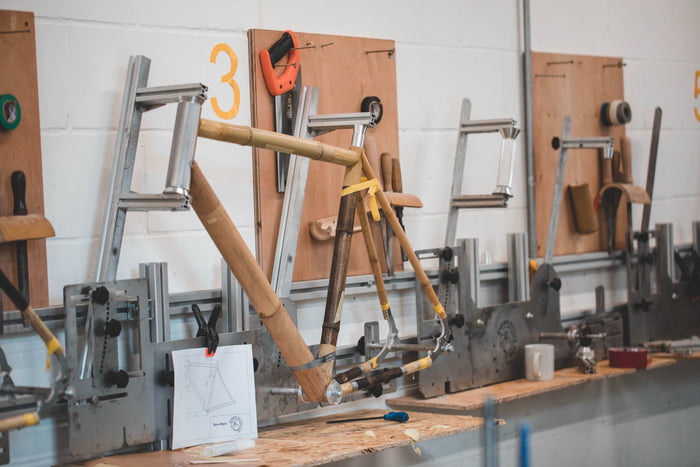
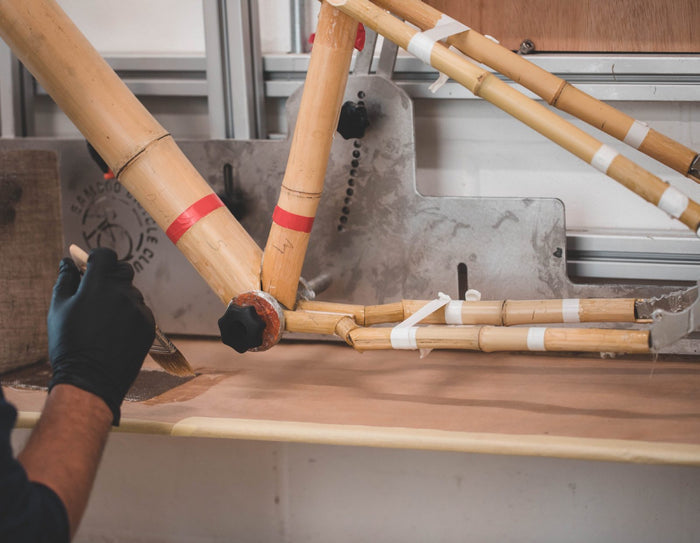
On Tuesday 4 March we ran a public masterclass at the Acava studio, Spode Works, Stoke-on-Trent, for a smaller group of makers, crafters and creatives. The day moved from making small bamboo products in the morning to the heart of the class in the afternoon: planning bike-frame geometry, then mitring, shaping and fitting bamboo tubes into prefabricated lugs — the same lugged frame-build method we teach in London.
The teaching follows the same hands-on approach behind our OCN London Level 2 accreditation: learn by doing, with a real object taking shape on the bench in front of you.
The outcome
Across the two days we introduced a new group of students and makers in a new part of the country to frame-building with bamboo — and proved that the methods we have developed over more than a decade can travel, and can be delivered alongside a strong local partner. Brilliant Bamboo had skilled tuition for its programme; we reached people who would never have travelled to London. Both organisations came away with reason to keep working together.
Why it matters
We have trained more than 4,000 people across 36-plus countries since 2012, and none of that happens if the knowledge stays locked in one workshop. Stoke is a small, honest example of how it moves: a bench, a pile of canes, a college group and a local partner — and people finding out they can build something they never thought they could.
Proof and links
- Partner: Brilliant Bamboo CIC (founder Gemma Thomas), Stoke-on-Trent / Staffordshire
- Network: the Bamboo in the UK group
- Original write-up: Insights from Our Stoke Workshop with Brilliant Bamboo (5 March 2025)
Note: further-education students may be under 18; no individual student is named or identified here.
Bring it to your school
Hands-on STEM your students can build — mapped to the curriculum. Start with a free speaker session.
Bring it to your school →